

Variable refrigerant flow (VRF) systems, which were introduced in Japan more than 20 years ago, have become popular in many countries, yet they are relatively unknown in the United States. The technology has gradually expanded its market presence, reaching European markets in 1987, and steadily gaining market share throughout the world.
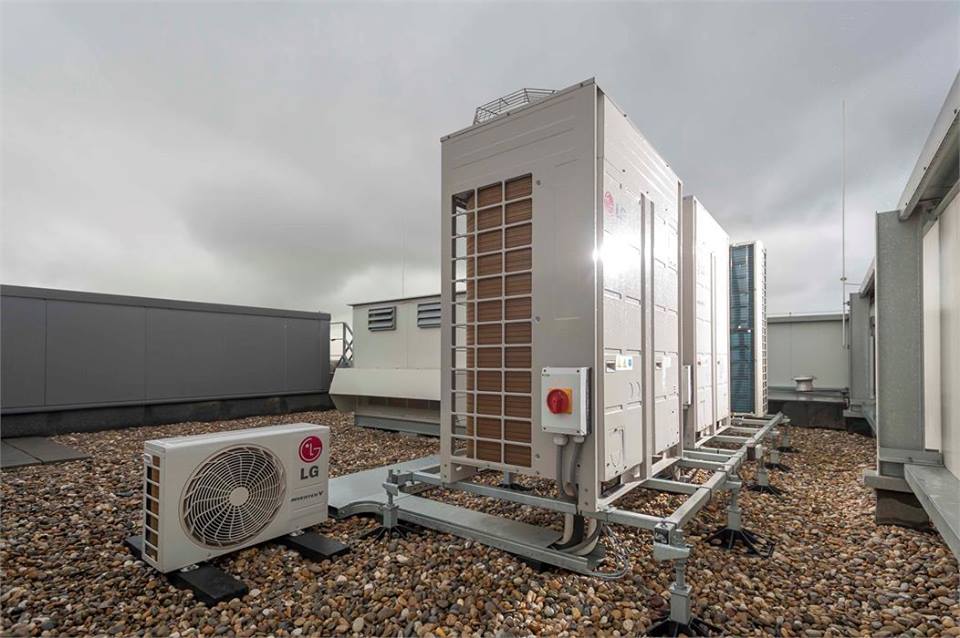
In Japan, VRF systems are used in approximately 50% of medium-sized commercial buildings (up to 70,000 ft2 [6500 m2]) and one-third of large commercial buildings (more than 70,000 ft2 [6500 m2])
What is VRF?
Many HVAC professionals are familiar with ductless mini-split products. A variation of this product, often referred to as a multi-split, includes multiple indoor evaporators connected to a single condensing unit. Ductless products are fundamentally different from ducted systems in that heat is transferred to or from the space directly by circulating refrigerant to evaporators located near or within the conditioned space. In contrast, conventional systems transfer heat from the space to the refrigerant by circulating air (inducted systems) or water (in chillers) throughout the building. VRF systems are larger capacity, more complex versions of the ductless multi-split systems, with the additional capability of connecting ducted-style fan coil units. They are inherently more sophisticated than multi splits, with multiple compressors, many evaporators, and complex oil and refrigerant management and control systems. They do not provide ventilation, so a separate ventilation system is necessary. The term variable refrigerant flow refers to the ability of the system to control the amount of refrigerant flowing to each of the evaporators, enabling the use of many evaporators of differing capacities and configurations, individualized comfort control, simultaneous heating and cooling in different zones, and heat recovery from one zone to another. This refrigerant flow control lies at the heart of VRF systems and is the major technical challenge as well as the source of many of the system’s advantages.
VRF Benefits
VRF systems have several key benefits, including:
- Installation Advantages. Chillers often require cranes for installation, but VRF systems are lightweight and modular. Each module can be transported easily and fits into a standard elevator. Multiples of these modules can be used to achieve cooling capacities of hundreds of tons. The relatively light weight of the system also may reduce requirements for structural reinforcement of roofs. Because ductwork is required only for the ventilation system, it can be smaller than the ducting in standard ducted systems, reducing building height and costs. In cases where operable windows are present and meet code requirements for ventilation, VRF systems are also particularly suitable for retrofitting historical buildings without disturbing the structure or for older buildings with no air conditioning.
- Design Flexibility. A single condensing unit can be connected to many indoor units of varying capacity (e.g., 0.5 to 4 tons [1.75 to 14 kW]) and configurations (e.g., ceiling recessed, wall-mounted, floor console). Current products enable up to 20 indoor units to be supplied by a single condensing unit. The modularity also makes it easy to adapt the HVAC system to expansion or reconfiguration of the space, which may require additional capacity or different terminal units.
- Maintenance and Commissioning.VRF systems with their standardized configurations and sophisticated electronic controls are aiming toward near plug-and-play commissioning. Because they are DX systems, maintenance costs for a VRF should be lower than for water-cooled chillers, so water treatment issues are avoided. Normal maintenance for a VRF, similar to that of any DX system, consists mainly of changing filters and cleaning coils. However, chillers, which often operate for 20 to 30 years, normally would be anticipated to have a longer life expectancy than a DX system such as a VRF.2 The large number of compressors in a VRF may create a higher probability of compressor failure, although the redundancy also leads, in many cases, to a greater ability to continue to occupy the space while repairs are made. • Comfort. Many zones are possible, each with individual setpoint control. Because VRF systems use variable speed compressors with wide capacity modulation capabilities, they can maintain precise temperature control, generally within ±1°F (±0.6°C), according to manufacturers’ literature.
- Energy Efficiency. The energy efficiency of VRF systems derives from several factors. The VRF essentially eliminates duct losses, which are often estimated to be between 10% to 20% of total airflow in a ducted system.3 VRF systems typically include two to three compressors, one of which is variable speed, in each condensing unit, enabling wide capacity modulation. This approach yields high part-load efficiency, which translates into high seasonal energy efficiency because HVAC systems typically spend most of their operating hours in the range of 40% to 80% of maximum capacity.